
Keeping bears out of your bees
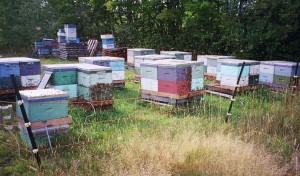 Some bears are especially fond of larval bees and honey and will actively seek out hives in their home range. Consequently, beehives should be located as far as possible from timber and brush providing bears with cover and travel routes. Honey crops should be harvested as soon as possible after the spring, summer and fall nectar flows to reduce the attractiveness of hives to foraging bears, and prevent the loss of the new honey crop in the event of depredation. When possible, apiaries should be moved to new locations if bear activity is detected nearby.
To minimize possible damage to hives and prevent bears from establishing bad habits, apiaries in occupied habitat should be protected using electric fences, or at a minimum use bear-resistant platforms (with an overhang more than two meters above the ground). Recently, a clever inventor created a bear-resistant bee hive. Check them out here.
Electric fencing has been shown to be almost 100 per cent effective in deterring bear damage. Compact apiaries are easier to protect with bear-resistant fencing than those scattered over a larger area, so beekeepers should consolidate hives to form the smallest apiary that can be practically managed.
Electric Fence tips for Beekeepers
Winter yards can be equipped with barbed wire and posts as these are more susceptible to bear damage in the spring. To prevent sagging under the weight of snow, run 5 strands about six inches apart. Power up the strands as they become accessible with the melting snow.
In summer yards, run four strands with the last strand at hip height. Keep the colonies at least four feet away from the fence as bears may reach under to topple a hive.
When setting up posts, make sure the corner posts are leaning out from the pen so that when you tighten the wires, tension is maintained.
Fences can be powered by deep cycle twelve volt batteries with the charge maintained by solar panels. This helps you avoid having to change batteries every two weeks – with the panels, the battery maintains its charge for about six to eight weeks depending on the grass load.
A good deep ground rod is the key to a good fence. If the ground is dry or rocky, put in several ground rods spaced out by 6 feet until the fence puts out good voltage – anything less that 6500 volts is not acceptable.
Make sure you have a good voltage tester to measure volt output on the fence.
If you are running solar panels with your fencer, you can’t rely on the voltage reading unless you cover the panel (as it will power the fence during the daylight even if your battery is down). Once the sun drops, so does your fencer. Carry a battery tester and check both the fence voltage and the battery. Some models have a low battery light indicator which is a nice feature.
The setup should be kept inside the enclosure anyway to prevent the bear from tampering with it.
Editor’s note: While it may seem counterintuitive, it’s a good idea to train bears to avoid your electric fence after it’s installed. Apply a smell to the electric fence to attract the bear’s nose. This can be done by putting food grease on a sponge and keeping a fresh coat on the wires. Bears, when they encounter a new smell will test it with their tongues tranfering the smell to their vomeronasal orgain papilla behind their incisors. Once they are zapped they will have little interest in what is being protected. Otherwise bears are like sheep and their dense fur can insulate them from being shocked by an electric fence.
Other references:
Buy a portable electric fence.
Download Building a Secure Beehive Enclosure