
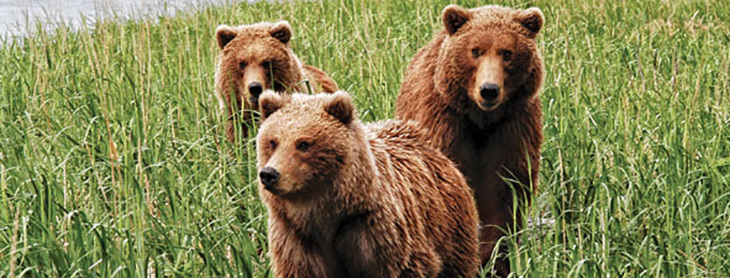
Keep bear encounters positive and conflict-free
Hiking, mountain-biking and camping in bear habitat is an exhilarating way to spend a day, a week or a month. And seeing a bear is far more likely to enhance your wilderness experience than spoil it. Knowing what to do and how to behave when the moment comes will keep you and the bear safe – and your spirits high!
Bears don’t like crashing through bushes any more than people do, and are often found on trails, especially early in the morning, near dusk and at night. – Linda Masterson in Living with Bears (pg 177)
Here’s how you can make your backcountry (bear) experiences positive and conflict free:
- Be prepared! Learn how and why bears behave and know how to react to an encounter or attack. If you’re recreating in grizzly country, ensure you can tell the difference between a black and a grizzly bear.
- Before setting out, check with the appropriate authorities (provincial wildlife officer, park warden, etc.) to see if there has been any bear activity along your route. Obey all trail closures and information signs. If there are bears in the area, consider choosing a different route.
- Always, always carry bear spray or another deterrent – and know how to use it.
- Stay alert and watch for bears and bear signs. Tracks, trampled vegetation or scat are all signs that bears may be nearby. Be especially alert where bear foods are abundant.
- Make lots of noise. If a bear hears you coming, it will usually avoid you. Warn bears of your presence by talking calmly and loudly or singing, especially in dense bush where visibility may be limited or around rivers or streams where bears have trouble hearing you coming. Your voice will help identify you as human and non-threatening.
- Travel in a group during daylight hours. Especially in grizzly country. There is no record of a bear attacking a larger group of people.
- Avoid animal carcasses. Make a wide detour if you smell or see signs of a dead animal (e.g. ravens circling). Black and grizzly bears can kill large animals for food, and they are attracted to carcasses that have been killed by other causes. Leave the area if possible.
- Keep dogs on a leash and under control. Dogs may be helpful in detecting bears, but they may also agitate them and create a conflict situation – sometimes returning to their humans with the bear in pursuit.
- Keep your distance. Never approach bears. If a bear (or any animal) approaches, back away in order to maintain a safe distance. Use binoculars, spotting scopes and telephoto lenses to view and photograph wild animals up close. Get more tips here.
- Secure all potential bear attractants. Never feed a bear, either intentionally or unintentionally, by being careless with your garbage or food scraps. Always store your food and garbage in a bear-proof container or hang it in a tree. Securing your campsite with a light-weight, portable electric fence is another effective alternative.
Some bears that are startled by fast-traveling joggers and bikers run away. Some don’t. – Linda Masterson in Living with Bears (pg 181)
.
Download our Bear Smart Guide for Campgrounds – English; German; and Dutch.
Video:
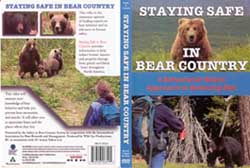
Staying Safe in Bear Country is the main 50-minute video that is a stand-alone educational tool for anyone living, traveling or working in bear country. It includes the consensus opinion of leading experts on bear behaviour and its relevance to human safety.
People who watch the video will develop a better understanding of bear behaviour and how this knowledge can help them prevent bear encounters and attacks.
The entire script and the main messages are available online. Copies of this videso can be purchased online from Kodiak Wildlife Products Inc. They can be purchased for home use or with Public Presentation Rights (PPR), which means they are licenced to allow showings to non-paying audiences.
Brochures:
Download brochures and flyers for home, play or your business. These are specifically designed for Whistler residents, businesses and visitors. Most of our guides can be printed on 8.5 x 11″ paper; front and back; and then folded twice. Please note that some of the foreign language brochures (German, French, Spanish & Japanese) need to be printed on 8.5 x 14″ paper. Flyer-style guides can be printed on 8.5x 11″ paper.
Campers:
Bear Smart Guide for Campers – download in English; Deutsch (German); française (French) and Nederlands (Dutch). Printable version for campgrounds 3 flyers per 8.5 x 11″ paper – download in English; Deutsch (German);française (French) and Nederlands (Dutch).
Camping in Bear Country – download full colour brochure, printed on 8.5 x 11 front & back, folded twice.
Visitors:
Bear Smart Whistler Visitor’s Guide – download in English; Deutsch (German); Nederlands (Dutch); 日本 (Japanese); française (French) and español (Spanish) (most foreign languages need to be printed on 8.5 x 14″ paper; except Dutch).
Bear Viewing:
Where to find bears and how to behave while viewing them. Download a brochure here – page one and page two. Bear Viewing Info for Concierges and extra teaching points.
Your best defense in bear country is still your brain – your knowledge and understanding of bears.