
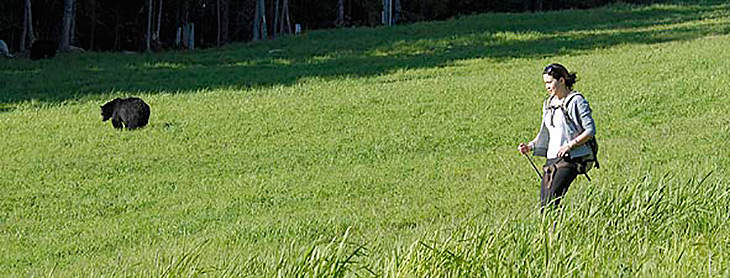
Be safe in bear habitat
It’s normal to be frightened when you encounter a bear. The reality is that most encounters with bears rarely lead to aggressive behaviour and attacks are even rarer. Remember, most bears prefer to avoid contact with humans, and any bear you do see is probably just as frightened as you are!
Remain as composed as possible and follow these simple guidelines whenever you are in bear country. Soon you too will have more composure when sighting a bear because you will know what to do.
Avoid, avoid, avoid
The best way to prevent an unpleasant bear encounter is to avoid them all together. Bears usually avoid people, and most people don’t even know when they’ve come close to a bear.
To ensure a surprise or unpleasant encounter with a bear doesn’t occur, avoid moving through bear habitat silently and alone. Travel in groups (the larger the better) and make lots of noise by talking or singing. And put the iPod away and pay attention to your surroundings.
When it happens
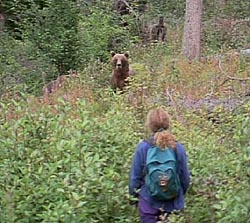 Remain calm and ready your bear spray (or other deterrent). Stay together if you are in a group; you will appear larger and more intimidating if you stick together.
Try to figure out whether the bear is a grizzly or a black bear. As you will see below, grizzly bears and black bears tend to behave differently in a given situation, so it helps to know which species you’re dealing with. (Click here to learn how to tell the difference.)
If possible, try to determine whether there are cubs present or whether the bear is defending an animal carcass or other food source. Females with cubs or bears defending food sources may appear to act aggressively as they defend their cubs and/or food.
Now that you know what you’re dealing with ….
Bears at a distance
If you see a bear in the distance, respect its need for personal space. Do not approach it, even to get a photo, and give it as much room as possible. Consider turning around and leaving the way you came. If you must continue, take a detour and give the bear a wide berth. Bears can cover large distances in a relatively short period of time, so if you are camping, be sure to store your food well out of reach of any bears in the area.
Close encounters of the bear kind
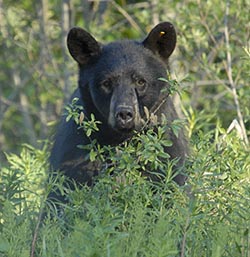 If you encounter a bear on the trail, or in your campsite, stop what you are doing and evaluate the situation. Identify yourself by speaking in a calm, appeasing tone. Back away slowly, preferably in the direction you came. Walk, don’t run, and keep your eye on the bear so you can see how it will react. In most cases, the bear will flee.
If you are in your campsite or other place bears shouldn’t be, and you are sure the bear is a black bear, consider trying to move it out of the area. Ensure the bear has a clear and safe escape route with no people or obstacles in its way. Stand tall and look it directly in the eye. Yell at the bear and firmly tell it to leave: “Get out of here, bear!” Keep a can of bear spray ready (with the safety removed) in case the bear approaches too closely. For more information on how to deter black bears, click here. Never try to move a grizzly bear!
Dealing with a ‘defensive’ encounter
Sometimes a bear that feels threatened will ‘act’ aggressively to defend against a perceived threat. This is often the case with a mother bear with cubs, a bear defending a food source, or a surprise encounter. The closer you are to the bear when it becomes aware of you, the more likely it is to react defensively: it may pop its jaws or swat the ground with its front paw while blowing and snorting, and/or it may lunge or “bluff charge” toward you in an attempt to get you to leave.
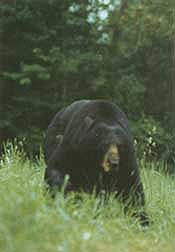 In this situation, the bear doesn’t want to fight any more than you do. It is simply trying to communicate that you are too close. Try to appear non-threatening by remaining still and calm. Ready your bear spray by removing the safety lock. Speak in an appeasing voice and back away, increasing your distance from the bear. Leave the area immediately.
Defensive responses that result in physical contact almost always involve grizzly bears surprised at close range, on a carcass or protecting young. The very few defensive attacks by black bears have been females protecting cubs (but these are very rare).
If you encounter a bear on a carcass, get as far away from the bear’s cache as possible; leaving the area quickly and quietly preferably in the same direction you came in. If the bear is about to make contact, use your bear spray. Do not play dead and do not act aggressively. Get as far away from the food cache as possible.
If a bear that is behaving defensively is intent on making contact, your first line of defence is always your bear spray. That should be enough to discourage it and send it in the other direction. (Click here to learn more about how to deploy bear spray.)
It’s the escalation of fear that leads to bad decisions. There have been a number of bear attacks that I’ve read about that could have been avoided if the situation hadn’t been misread. – Ben Kilham in Among the Bears (pg 244)
If the encounter was a surprise or it involves a mother grizzly bear with cubs, and the bear makes physical contact, fall to the ground and “play dead.” Roll over onto your stomach and cover your neck and the back of your head with your hands. Keep your legs and elbows wide so the bear can’t flip you over. When the attack stops, remain still and wait for the bear to leave. Do NOT get up until you are absolutely certain the bear is no longer in the area – even if you have to wait 30 minutes or longer.
If an attack is prolonged or the bear starts eating you, it is no longer being defensive and it is time to fight back (see next section).
Repelling an aggressive or non-defensive bear
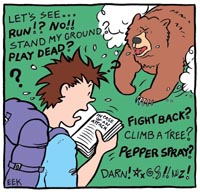 Occasionally, a bear will approach you in a non-defensive manner. It may just be curious. Perhaps it’s a young adult bear that is simply testing its dominance. Or they are used to hanging around peopled areas in order to access food. Very rarely, it may see you as potential prey.
In any event, talk to the bear in a firm voice. Get out of its way if you can, which may be all it wants. If the bear follows you and its attention is clearly directed at you, then stand your ground and prepare to use your deterrent. A bear that is initially curious or testing you may become predatory if you do not stand up to it.
Act aggressively. Look it straight in the eyes and let it know you will fight if attacked. Shout! Make yourself look as big as possible. Stamp your feet and take a step or two toward the bear. Threaten the bear with whatever is handy (stick, pole, bear spray). The more the bear persists, the more aggressive your response should be.
If the bear attacks, use your deterrent and fight for your life. Kick, punch or hit the bear with whatever weapon is available. Concentrate your attack on the face, eyes and nose. Fight any bear that attacks you in your building or tent.
Anyone interested in safety around bears should remember that the power to seriously injure or even kill is always there.” – Steve Herrero in Bear Attacks: Their Causes and Avoidance (pg 217)
Resources:
Staying Safe in Bear Country Video: Watch now or buy your own DVD.
Watch a short clip of Steven Herrero, author of Attacks: Their Causes and Avoidance, on black bear attacks.