
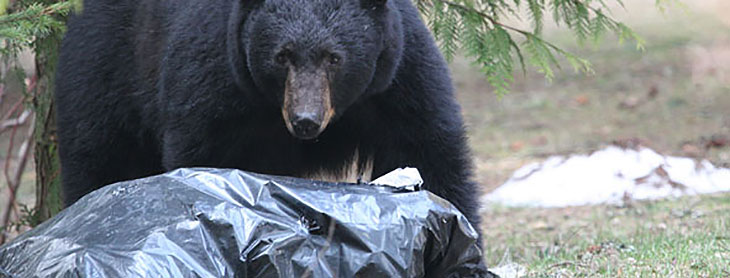
Bears are omnivores and have a varied diet based on seasonal food availability. What shouldn’t be on their menu is human-generated refuse. It is critical to the health and well-being of bears, and humans, to ensure all garbage and other human-generated waste is kept away from bears. This is the most important step you can take to minimize negative human-bear encounters. Unsecured residential and commercial garbage containers along with accessible and unsecured landfills and transfer stations are bear attractants. Once a bear gets a taste of human-generated refuse, they are likely to routinely approach communities and other developed areas in search of these non-natural food sources. This never ends well for the bear.
Bear-proofing a community’s waste infrastructure takes effort and involves a multi-tiered, multi-stakeholder approach. In order to ensure the safety of residents, visitors and wildlife, all public, residential and commercial waste containers in bear country must be bear-resistant to the highest standard possible.
It is incumbent on municipalities and districts that have well-established systems for curbside collection of household waste to provide the most effective containers for storage and curbside placement, as well as education about minimizing the attractants if the containers are stored outdoors.
Ideally, there should be no residential curbside collection of waste, but rather a system of residential communal bear-resistant waste containers where residents and visitors can conveniently take their refuse, organics & recycling. An alternative to community communal bear-proof waste containers is to designate one or two large waste transfer stations that service the entire community.
A community might also consider converting their waste to energy.
More detailed information on curbside containers, enclosures, communal waste containers, landfills and transfer stations can be found in the drop-down menus below.
There are numerous options and different models of containers to help meet the needs of residential, industrial, commercial, institutional (ICI), multi-family and solid waste company sectors. Some products are more bear-resistant than others e.g., plastic locking residential carts are more likely to be breached by a bear than a metal locking dumpster.
The following requirements will help you ensure the container you choose is bear-resistant:
- Lids and doors should be recessed, self-closing and tight fitting to prevent odours from escaping.
- Latches on all lids and doors must be bear-resistant (i.e., bear’s claws unable to reach the latch trigger mechanism).
- Hinges and latches for lids must be sufficiently strong such that they cannot be pried open by claws (able to withstand several thousands of pounds of force). The rule of thumb is that if it can be dismantled using a crowbar then it is not bear-resistant.
- If the container is not able to be stored indoors, it must be sufficiently stable or capable of being anchored to a solid, stationary base to prevent tipping by large bears.
- Container material must be sufficiently strong to prevent bears from chewing, battering or crushing the container.
- Container should be constructed from corrosion-resistant materials to prevent rust and ensure long product life.
- All containers should be tested and certified bear-resistant by an independent group, like the Interagency Grizzly Bear Committee (IGBC). Note: while strict standards guide both testing facilities, products that are certified are not guaranteed to be bear-proof.
Commercial, Industrial, Institutional (ICI) and Multi-family Bear-resistant garbage containers
Bear-resistant residential garbage containers
Bears will eat garbage because it’s an easy food source to find, requires very little energy expenditure and provides high caloric rewards. Consuming large quantities of digestible food allows bears to store large amounts of fat to survive the denning period. Since residential garbage contains concentrated calorie rich foods, it is a major attractant to bears and as such, contributes to non-natural and unhealthy food conditioning of bears.
Bear-resistant containers and enclosures allow residents and business-owners to responsibly store garbage and other bear attractants at home and at work. Many communities and municipalities are enacting solid waste and/or wildlife attractant bylaws that require all wildlife attractants be inaccessible to wildlife (if your community doesn’t have a bylaw/ordinance, here is a sample bylaw and a step-by-step guide to understanding the bylaw).
Bear-resistant curbside wheeled carts
The Interagency Grizzly Bear Committee (IGBC) Testing and WildSafeBC Testing provide testing and certification for various models of bear-resistant refuse containers and other products; best practices are to use certified products.
Some carts require the resident to manually lock and then unlock on the morning of collection, others latch automatically when the lid is closed and then unlock automatically as they’re being tipped by a fully automated truck. It is important to know the type of collection your community waste provider uses e.g., fully automated, semi automated, or manual as this will determine the type of container.
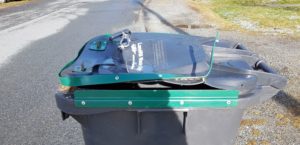
Bear damage to curbside locking cart
Note: Plastic residential locking carts (even those that have been certified) can suffer from damage, especially if left outdoors 24/7. In addition to general wear and tear, there are environmental impacts; e.g., freezing temperatures or UV exposure which can degrade and weaken the product over time. Additionally, if the containers are stored outdoors, bears have ample opportunity to troubleshoot and learn how to gain access. The best practice is to store refuse containers, specifically plastic residential containers, indoors or within a wildlife-proof enclosure. If there is no option for indoor storage, the containers should be anchored such that they can’t be tipped or dragged away. Regular cart inspections and timely repairs should be included in the community’s overall refuse management plan.
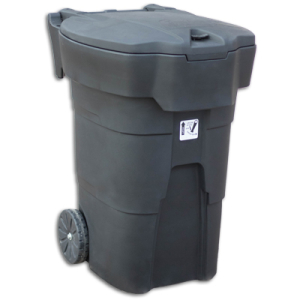
Kodiak Products polycart for curbside use
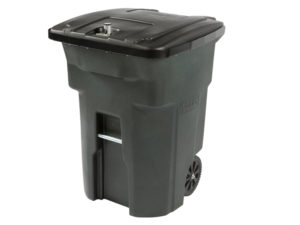
Toter residential cart for curbside use
Communal waste containers vs. individual residential containers
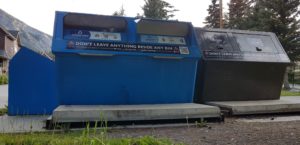
Communal Residential Containers, Banff
Community officials should seriously consider eliminating curbside pick up and consider implementing communal waste containers, this is a viable option for new residential developments to consider in the early stages of planning. The town of Canmore, Alberta implemented this system over a period of years in an effort to eliminate curbside collection and the issues associated with attracting bears into neighbourhoods. Read Canmore Experience
Six-yard metal garbage, organics and recycling containers can be strategically placed within a one-block radius of any residence allowing for convenient disposal of waste. This eliminates individual/per household garbage, organic and recycling containers left outdoors and accessible to wildlife.
Container Enclosures
If refuse cannot be stored indoors, enclosures are an effective way to prevent bears from accessing your household waste. It’s important to keep in mind that bears are able to smell odours from a great distance, so even if using an enclosure, it is imperative to wash recycling containers and freeze smelly food items, especially meat/fish scraps. These best practices will help to reduce odours that bring bears into our neighbourhoods and will drastically reduce the possibility of maggots and rats.
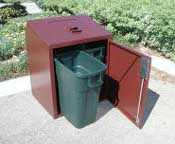
BearSaver Residential Can Enclosure for outdoor storage of trash
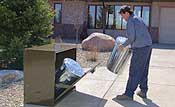
Haul-All Hid-A-Can for outdoor storage of trash
There are several companies in the U.S. and Canada that sell bear-proof containers designed specifically for residential use.
There are several solutions for municipalities and commercial interests to responsibly manage their waste streams.
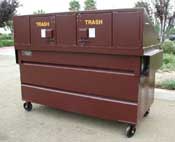
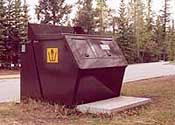
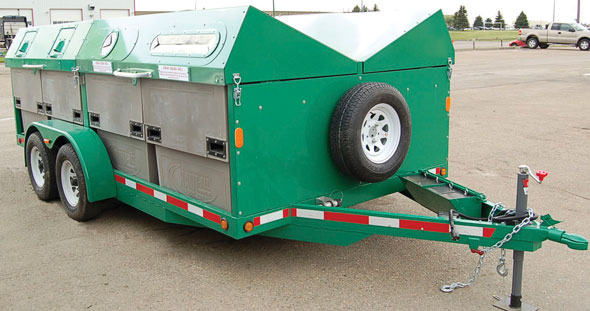
Haul-All Recycle Ranger, a mobile multi-compartment recycling /waste collection trailer
Wildlife-Proof Building Enclosures
The District of Squamish, BC implemented guidelines for ICI and multi-family wildlife-proof waste enclosures Waste Room Design Guidelines which also contain requirements on wildlife-proof enclosures for the storage of waste Solid Waste Enclosure.
A bear can crumple a flimsy, unlocked shed as easily as you can crush a modern day soda can.” – Bryan Peterson, Durango Bear Smart as quoted in Living with Bears, by Linda Masterson
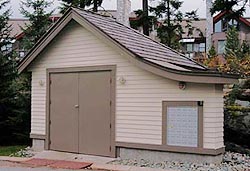
Good Bear-Resistant Enclosure:
- steel doors
- cement floor and upstand
- exterior walls made of
synthetic materials (not wood) with planks running horizontally
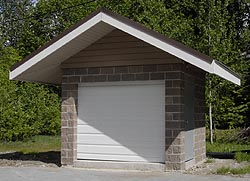
Best Bear-Proof Enclosure:
- separate door for waste hauler
- steel man door
- exterior built with cement blocks
Centrally located transfer stations with larger bear-proof compactors are another alternative for residential as well as ICI and multi-family waste disposal. Locating these transfer stations centrally will allow people without vehicles to get their garbage to the transfer station and compactor site. The transfer station must be staffed to ensure the proper disposal of waste and to prevent dumping of unacceptable garbage, such as appliances, mattresses and building materials. They must also be bear-proofed. The best method for bear-proofing a transfer station (or landfill) is to install and maintain a sturdy, electrified fence and gate. For more information on electric fencing, click here.
Each system has its advantages and disadvantages. For the most part, the easier and more convenient it is for humans to use the containers the more likely they are to do so.
Pedestrian Containers
All pedestrian containers throughout the community must be bear-resistant. To prevent illegal dumping, best practices are to install garbage, recycling and organic containers together.
Haul-All Equipment Systems
Bear Resistant Trash and Recycling Containers – Click on photo of each style for information.
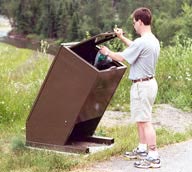
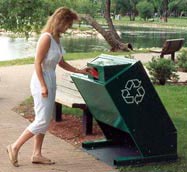
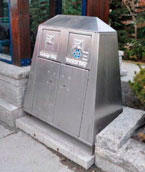
“This single product has done more to save the lives of bears and people than any single thing I can think of.” Dr. Steven Herrero, a world-renowned bear specialist on Haul-All Hyd-A-Way waste bins.
Read “The Importance of Infrastructure Development in Wilderness Locations” for more information about the significant social and financial benefits from investing in a community-based bear-proof waste management system.
These companies provide a variety of commercial and municipal bear-proof waste management options.
Grease Containers
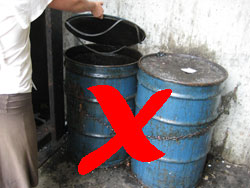 Grease containers offer a huge caloric reward to a foraging bear and the smell of used cooking oil is irresistible. Many restaurants and eateries use grease capture containers to store used cooking oil, which is then collected by companies that recycle the oil into products like biodiesel – an important environmental service. However, if stored incorrectly, grease containers can be easily accessed by bears – a full standard barrel contains 210 liters of oil which translates into a whopping 1.6 MILLION calories. In order to protect bears, reduce the potential for a negative human-bear encounter, and prevent negative environmental impacts, such as the used oil spilling into fish-bearing waterways, grease containers must be stored in a bear-proof container or within a wildlife-proof enclosure.
Step One: Where to Get Them
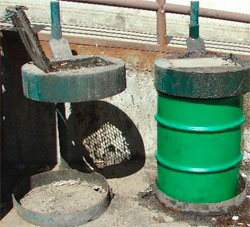 Certified bear-proof containers can be difficult to find, but companies do offer them. Be cautious if fabricating your own container to ensure that bear-proof specifications are met. See step three for key features. Product testing and certification are available at the Interagency Grizzly Bear Committee (IGBC) in the US or through WildSafeBC in Canada.
Step Two: Secure Storage Location
Grease containers must be located in an area that is inaccessible to bears, such as inside a building, on a secure loading bay or in a bear-proof garbage shed. It is crucial that any grease containers not located within an enclosure are properly affixed to the ground (feet bolted to the cement) or secured to a nearby wall or cement post (either with a heavy-duty chain or welded arm as shown above) to prevent bears from rocking and tipping it over.
S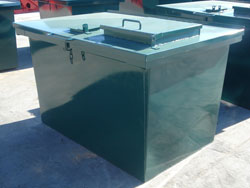 tep Three: Nuts and Bolts: Container Design
All containers should be designed in such a way that bears can not access the grease inside.
Key features include:
- lockable access points that prevent paws from reaching in to scoop out oil;
- heavy-duty commercial gauge steel resistant to bear damage (with no gaps in-between where bears can pry open a lid);
- user-friendly dual-action locking mechanism (such as a padlock or other mechanism).
Click here to watch a demonstration of a grease barrel that is not user-friendly and as a result not bear-proof.
 Step Four: Maintenance
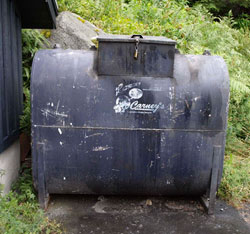
Grease containers must be kept locked, secured, and in proper working order at ALL TIMES. In addition, all grease containers (as well as garbage areas and loading bays) must be kept clean and free of odour. This means frequent power washing with hot soapy water.
Landfills or Transfer Stations
Feeding on human garbage can cause numerous health concerns for bears – extensive tooth decay, lacerations on the paws and mouth, internal damage to organs from sharp objects, plastics blocking the intestines, poisoning from ingestion of toxic substances and parasitic infections can all cause illness and death.
Ideally, open-pit landfills should not exist in high density bear country. If your community has a landfill, and installing bear-resistant transfer stations are not an option, then a well-designed and properly installed electric fence will assist with preventing bears from accessing the site.
Because landfills and transfer stations contain large amounts of attractants and bears are highly motivated to seek out food, there are a few considerations to keep in mind:
- To prevent bears from digging under the fence, extend the fencing out from its base about one foot below the surface.
- If gates are left open, bears can enter and get caught inside; two options for preventing access through open gates: (1) automatic sliding gates that open and close when the weight of a vehicle passes over the entrance, and (2) electrified cattle grate entrance. Of these two options, the second will be more effective and easier to use.
- Daily perimeter patrols should be conducted to ensure the fence is fully functioning. Ongoing fence maintenance is essential to successfully deter bear activity.
- Click here to learn more about how you can use electric fencing to secure landfills and other bear attractants.
When retiring a landfill, consider covering and/or burying it and then leaving it unfenced. Bear biologist Dr. Lana Ciarniello suggests that since the site remains accessible for bears to venture through, rummage around and find little if anything to eat, they will simply move on to another available food source in the same way they would respond to a natural food failure. But if bears are excluded from the site by a fence, more problems may occur because bears hang around the area and make repeated attempts to break in.
Landfill-scale electric fencing products and supplies can be found at the following retailers:
High River, Alberta Canada
t: 403-652-1932
Palmer, Alaska USA
t: 907-232-9758
Edmonton, Alberta Canada
t: 780-453-1516 toll free: 800-252-7547
Fencing supply catalogue.